According to new market surveys, it’s been revealed that smartphone users are buying bigger phones as they do more on screens, and spend less time talking on the phone. And there’s no sign of the appetite for super-sizing mobile handsets abating — not according to a new report from Yahoo-owned mobile analytics firm Flurry.
The firm has looked at a top slice of data taken from the 1.6 billion devices it tracks every month — focusing on the top 875 devices it says accounted for 87 percent of sessions in March 2015 — to explore global active device usage by screen size. Flurry found that phablets have more than tripled their share of usage since last year.
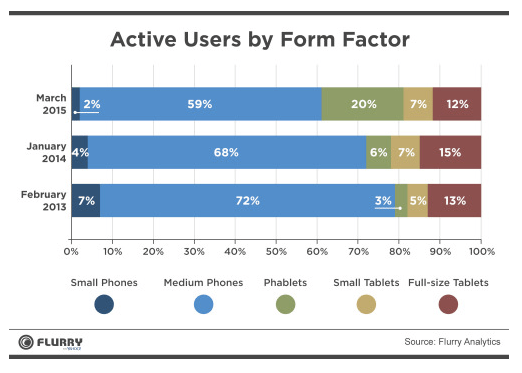
In January 2014, Flurry recorded just 6 percent of active users were on phablets versus 68 percent using ‘medium phones’ (devices with a screen size between 3.5 inches and 4.9 inches). But by March this year phablet usage had swelled to a fifth (20 percent), with medium phones squeezed down to 59 percent. Full-sized tablets are also being cannibalized — or capped — by phablets, with a shrinking overall share of active users:
Apple’s first phablet, the iPhone 6 Plus, went on sale last fall — finally affording iOS users who want to remain on Apple’s platform the option of using an i-Phablet. That pent up demand has evidently contributed to driving phablet usage. That said, Android remains the dominant force in phablets — which is not surprising, given how many more large-screened Android smartphones there are to choose from versus just the one iPhone.
Flurry found that around one-third (36 percent) of Android users are using phablets versus just 4 percent of iOS users. So iOS developers are still mostly going to be focused on building smaller phone experiences — and on iPad apps (full-sized tablet usage accounts for a fifth of iOS usage).
By contrast, Android usage on full size tablets is very weak (just 3 percent) — underlining what we knew already: that Android tablets have flopped, but also that there has been less impetus and demand for full-sized Android slates because Android phones have had larger screens for longer.
The firm has looked at a top slice of data taken from the 1.6 billion devices it tracks every month — focusing on the top 875 devices it says accounted for 87 percent of sessions in March 2015 — to explore global active device usage by screen size. Flurry found that phablets have more than tripled their share of usage since last year.
In January 2014, Flurry recorded just 6 percent of active users were on phablets versus 68 percent using ‘medium phones’ (devices with a screen size between 3.5 inches and 4.9 inches). But by March this year phablet usage had swelled to a fifth (20 percent), with medium phones squeezed down to 59 percent. Full-sized tablets are also being cannibalized — or capped — by phablets, with a shrinking overall share of active users:

Apple’s first phablet, the iPhone 6 Plus, went on sale last fall — finally affording iOS users who want to remain on Apple’s platform the option of using an i-Phablet. That pent up demand has evidently contributed to driving phablet usage. That said, Android remains the dominant force in phablets — which is not surprising, given how many more large-screened Android smartphones there are to choose from versus just the one iPhone.
Flurry found that around one-third (36 percent) of Android users are using phablets versus just 4 percent of iOS users. So iOS developers are still mostly going to be focused on building smaller phone experiences — and on iPad apps (full-sized tablet usage accounts for a fifth of iOS usage).
By contrast, Android usage on full size tablets is very weak (just 3 percent) — underlining what we knew already: that Android tablets have flopped, but also that there has been less impetus and demand for full-sized Android slates because Android phones have had larger screens for longer.
